Vaelor

SELF-HOSTED CODE INTELLIGENCE MCP SERVER · APACHE-2.0

Give your coding agent a memory of the codebase it can't get from grep.

Vaelor parses, graphs, and watches 16 languages, exposing 30+ MCP tools over one Apache-2.0 endpoint you run yourself.

Languages
16
MCP tools
30+
License
Apache-2.0
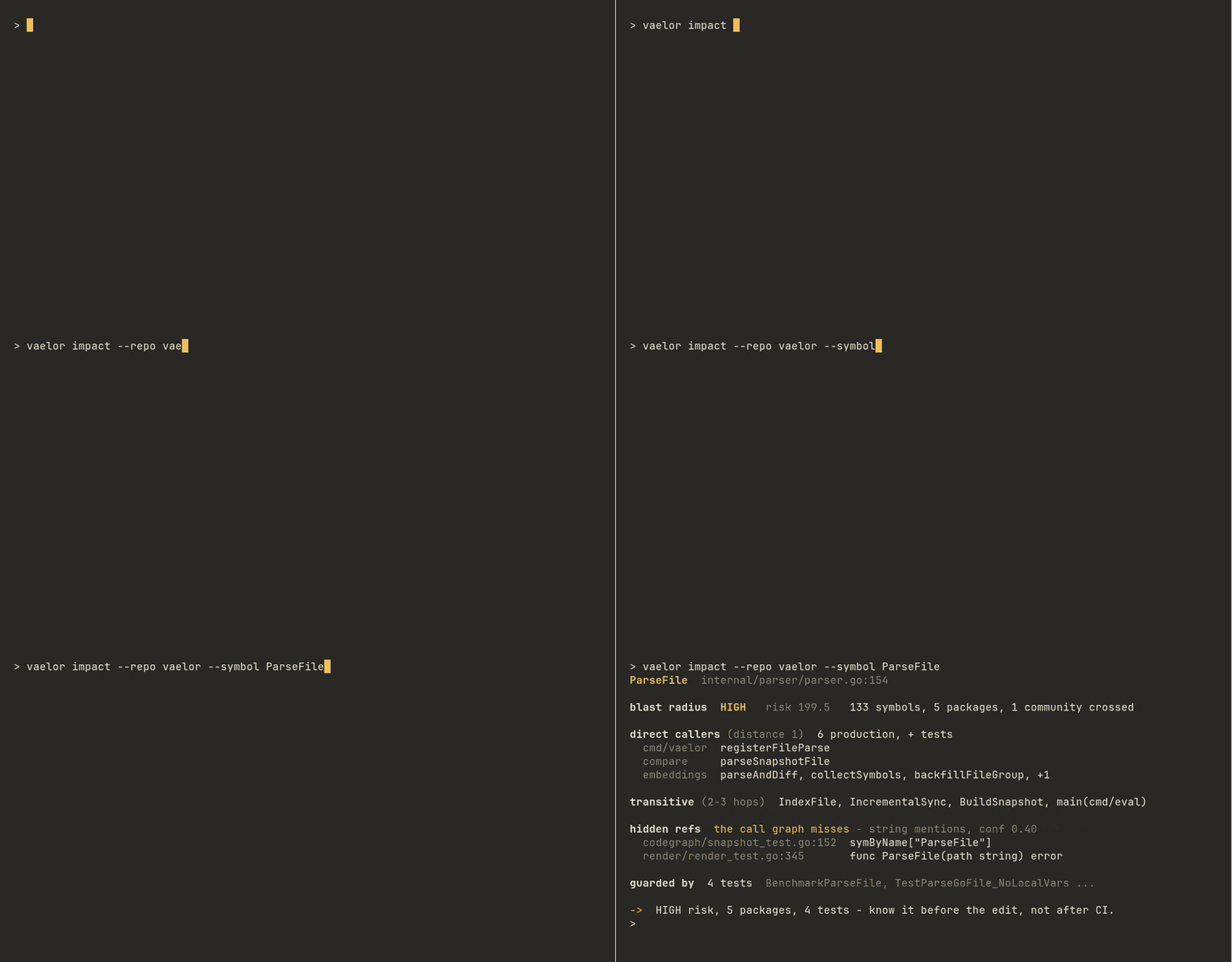
Vaelor impact on ParseFile: before an agent edits a hot function it sees the real blast radius — HIGH risk, 133 symbols across five packages, the transitive callers, the string references the call graph misses, and the four tests that guard it. Known before the edit, not after CI.

KNOWLEDGE GRAPH

What Vaelor remembers.

Your code as a property graph, indexed for agents. Every symbol, every call edge, every import, every test relationship. Queried in natural language via Cypher.

debug_investigate

From Prometheus alert
to file:function in 5 seconds.

Six-phase async pipeline: failure spikes, Jaeger failed traces, symbol resolution, callgraph walks upstream and downstream, log excerpts, LLM fusion. Returns ranked hypotheses with body excerpts. No one else does this.

Cypher via
natural language.

Apache AGE property graph on PostgreSQL. Every symbol, call edge, import, route handler, test relationship. Query the graph from plain English: Vaelor translates to Cypher and returns structured results.

Generated Cypher
MATCH (caller:Symbol)-[:CALLS]->(fn:Symbol)
WHERE fn.name = 'ValidateToken'
  AND fn.package = 'auth'
OPTIONAL MATCH (fn)-[:TESTED_BY]->(test:Symbol)
RETURN caller.name,
       caller.file,
       caller.line,
       test.name AS test_coverage
ORDER BY caller.file;
37 callers · 12 untested
auth package — 3 files, 6 symbols, 3 tests. Apache AGE on PostgreSQL.

dataflow_analyze + rewrite

Taint tracking.
Structural codemods.

IL/CFG analysis traces values from source to sink. Detects dead stores, unescaped user input reaching SQL or command execution. Rewrite applies AST search-replace patterns across all 16 languages with wildcard matching, survives multi-line code that regex can't touch.

rewrite — errors.New to fmt.Errorf · 247 matches
Go · AST search-replace 247 files
@@ auth/token.go:88 @@
 return errors.New(msg)
 return fmt.Errorf("%s: %w", msg, err)

@@ db/query.go:44 @@
 return nil, errors.New(queryErr)
 return nil, fmt.Errorf("query: %w", queryErr)

@@ cache/store.go:71 @@
 return errors.New(cacheErr)
 return fmt.Errorf("cache: %w", cacheErr)

... +244 more
Pattern errors.New($MSG) → fmt.Errorf("%s: %w", $MSG, err)
247 matches
13 languages
dry-run safe preview

positioning

Where the graph lives.

grep sees text. LSP sees one file's types. Sourcegraph indexes repos for humans. Cursor's indexing is locked inside one editor. Vaelor ships the same structural depth as a portable, MCP-native endpoint any agent can call — Claude Code, Cursor, Windsurf, Aider, Cline. No editor lock-in, no per-session rebuild.

Vaelor sits at the intersection no other tool occupies: structural depth (AST + call graph + type resolution) at multi-repo scale, portable across every MCP-capable agent. The top-right quadrant belongs to agents.

quickstart

Five minutes from clone
to first MCP call.

Requires OpenAI-compatible LLM endpoint
Unlocks more PostgreSQL + AGE pgvector ox-embed-server ox-codes Redis

Just an LLM endpoint and you have repo analysis, call tracing, structural rewrite, dataflow, and PR review. Add Postgres + AGE for code_graph; ox-embed-server + pgvector for semantic_search and code_research reranking; ox-codes for stricter dead_code + full code_health grades. Redis is just an L2 cache. All companions are open source.

vaelor quickstart
$ docker build -t vaelor .
Building vaelor ... done

$ docker run -p 8897:8897 \
    -e LLM_API_BASE=http://host.docker.internal:8317/v1 \
    -e LLM_API_KEY=your-key \
    vaelor
MCP server listening on :8897

$ claude mcp add -s user -t http vaelor http://127.0.0.1:8897/mcp
 registered — Claude Code can now call vaelor

Full quickstart on GitHub

FAQ

Questions you're already asking.

Why not just grep or ripgrep?

grep and ripgrep find the function. They don't tell an agent what else breaks when it changes, and they don't remember your last review or your last production incident. Vaelor parses 16 languages with tree-sitter, builds a call graph with type-aware Go resolution, and exposes 30+ MCP tools — understand, impact_analysis, call_trace, review_pr, debug_investigate — that surface blast radius, dead code, and prior review verdicts. The structural depth grep can't reach is the whole point.

Why not an LSP, or Sourcegraph?

An LSP gives you type-aware navigation inside one file in one editor. Sourcegraph indexes code for humans — full-text and symbols across an org, but no MCP, no call graph, no runtime view. Vaelor sits where neither does: structural depth (AST + call graph + type resolution) at multi-repo scale, exposed as a portable MCP endpoint any agent can call. It also adds what neither has: an Apache AGE knowledge graph carrying PageRank, community, and surprise scores, and a runtime observability bridge that correlates a Prometheus alert and a Jaeger trace back to the function that caused it.

Why not Cursor's built-in indexing?

Cursor's indexing is structural-ish, but it only serves Cursor — the index, the embeddings, and the chunk graph live inside one editor and one vendor's cloud. Vaelor is MCP-native, so the same endpoint serves Claude Code, Cursor, Windsurf, Aider, Cline, or any client implementing the Model Context Protocol. It's also self-hosted and Apache-2.0: you run the binary, you own the graph, the code never leaves your infrastructure. No editor lock-in, no vendor index.

Isn't running Postgres + Apache AGE + pgvector + an embedder a lot of ops?

Day one is two commands: docker build and docker run with an OpenAI-compatible LLM endpoint. That gives you call_trace, understand, impact_analysis, code_search, dead_code, code_health, repo_analyze, and the rest of the ~30 tools that don't need a graph or embeddings. Add PostgreSQL with Apache AGE (DATABASE_URL) to enable code_graph and the persistent PageRank/community/surprise signals. Add pgvector + an embedder (EMBED_URL) to enable semantic_search and code_research reranking. Redis is optional L2 cache. Each sidecar unlocks a specific tool family — nothing is required for the core, and the core is most of the tools.

What does it work with?

Any MCP client. Vaelor speaks Streamable HTTP over the Model Context Protocol, so you register one URL and it works with Claude Code, Cursor, Windsurf, Aider, Cline, and any future client that implements MCP. One server, every agent — no per-editor plugin to maintain.

Which languages does it support?

16: Go, Python, TypeScript/JavaScript, Rust, Java, C, C++, Ruby, C#, PHP, Svelte, Astro, Vue, Kotlin, Swift, and HTML. Tree-sitter AST parsing across all of them. Type-aware call resolution is live today on Go via go/types; SCIP-backed type resolution for the other languages is on the roadmap.

What's the licence, and is there a managed option?

Apache-2.0 across the whole stack — engine, companions, and site. Self-host it, fork it, run it inside your firewall. There is no hosted SaaS today. A managed option is coming on krolik.tools for teams that don't want to operate the sidecars themselves; until then, self-hosting is the only path and it's free.

Do I need an LLM API key to try it?

No. Most tools run without LLM_API_KEY — they skip only the narrative and ranking layer. call_trace, impact_analysis, dead_code, code_search, code_graph, and the structural tools return their raw structural results. Add an OpenAI-compatible endpoint (LiteLLM, CLIProxyAPI, or any wrapper) to get the LLM narratives and the reranker on code_research. The key is a capability unlock, not a gate.